Mia Kellman and Alana Lieske each received "Top 5" poster awards at the MINDS Post-Baccalaureate Poster Symposium on June 13th!
This was a wonderful event where post-bac research technicians in the neurosciences had a chance to present work, make new connections, and appreciate one another.
Find the story featured on the MIDB Synapse/Newspage here
Mia Kellman and Alana Lieske
Name the TMS Robot Contest
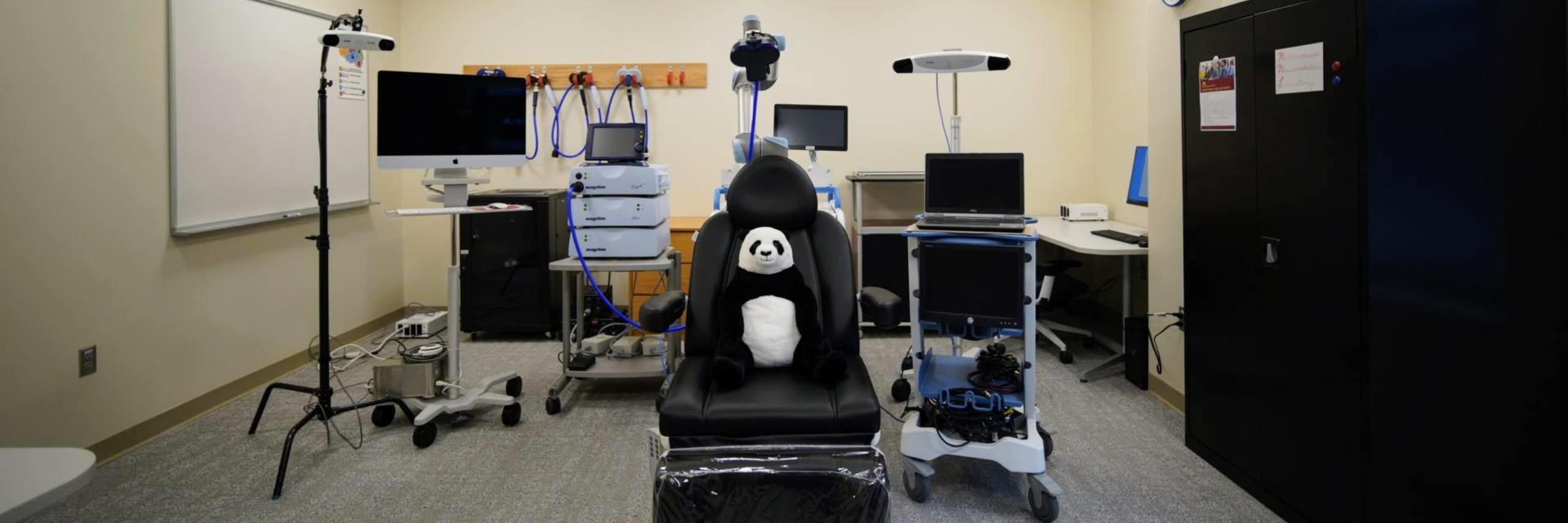
Two NNL facilities dedicated to pediatric neuromodulation research have been established at the Masonic Institute for the Developing Brain. One of these labs includes a robotized TMS system, of which there are only a handful in the U.S. and 40 in the world! We invited the community to celebrate with us by sponsoring a “Name the TMS Robot Contest,” inspired by the Minnesota Department of Transportation’s annual Name a Snowplow contest. We've narrowed the name submissions to our top selections and invite you to vote now on your favorite name!
Welcoming Undergraduate Research Assistants
This Fall semester, we have two Undergraduate Research Assistants (RA) joining the NNL team: Adam Behun and Shreya Srinivasan! These RAs will soon be available to assist our lab users with data collection, entry, and analysis. Please join us in extending a warm welcome to them!
Research assistants Adam Behun (l) and Shreya Srinivasan (r) after an afternoon of training in the pediatric NNL at MIDB!
Coming Soon: NNL Website
The NNL is actively working on creating a distinct website to provide information for researchers and community members alike! Once launched, laboratory guidelines, documents, photos, and virtual tours will be accessible there.
Learn more about our pediatric laboratories on our Neuromodulation Hub webpage
Our new NNL logo
Brain Awareness Week
Watch our informative video about non-invasive neuromodulation and what our research core does on MnDRIVE Brain Condition's new YouTube channel.
Learn more about Non-invasive Neuromodulation and the NNL research core
New Website Launched
NNL has a NEW website!!! Please check it out and learn more about the services we provide and what non-invasive neuromodulation is.
MnDRIVE Non-invasive Neuromodulation Laboratories
Pictured from left to right: Mia Kellman, Dr. Kelvin Lim, Dr. Christine Conelea, and Alana Lieske. Not pictured: Dr. Alexander Opitz, Dr. Mo Chen.
The Non-invasive Neuromodulation Laboratories (NNL) celebrated their 10th anniversary on Friday, January 10th over lunch at the Tea House, reflecting on a decade of research support and growth. Approximately 50 studies using non-invasive brain stimulation have been supported by the NNL since its establishment in December 2014. Last year over 532 experiment visits took place in the NNL, totalling more than 1,600 hours of data collection.
We are on Instagram!
Stay connected and follow NNL here
Farewell and Best Wishes to Mia Kellman
The MnDRIVE Brain Conditions team extends our sincere gratitude to Mia Kellman, Research Professional in the Non-invasive Neuromodulation Laboratories (NNL) Research Core, as she embarks on an exciting new chapter. After making many valuable contributions to the NNL by supporting investigators, research participants, and innovative neuromodulation research, Mia is leaving the laboratory to pursue her dream of attending medical school.
Mia joined the NNL in 2021 as a Volunteer Research Assistant and was hired on full time as a Research Professional in summer of 2022 upon completion of her Bachelor of Science in Psychology from the University of Minnesota. During her tenure in the NNL, Mia has provided technical training to dozens of incoming researchers and guided hundreds of clinical research participants through non-invasive brain stimulation protocols with compassion. Mia's comforting presence, contagious joy, technical expertise, and excitement for science will be greatly missed by our research community, but we know she will excel in the next stage of her career as she enters into Medical School at the University of Minnesota this Fall semester. We are incredibly grateful for her contributions and know she has a bright future ahead in medicine.
Congratulations, Mia, on this exciting next step! We wish you every success in medical school and beyond. You will be greatly missed, and we look forward to seeing all that you accomplish in the years to come.